The Best Fishing Book for Kids Might Not Be the Best One for Adults
Why childhood curiosity matters more than we sometimes realize when introducing children to fishing.
By Paul Amdahl
Imagine taking a ten-year-old fishing for the first time.
You've packed the fishing rods, selected the right tackle, checked the weather, and chosen a good place to fish.
Meanwhile, the child is wondering whether that big grasshopper in the backyard would make good bait.
Or what might be living underneath that old log near the water.
Or whether there's a fish in the lake big enough to pull the rod right out of his hands.
You're both thinking about fishing. But you're thinking about two very different things.
And that difference matters when choosing a fishing book for kids.
Children See Fishing Differently
Most adults approach fishing as something to learn how to do well.
We want to understand the equipment, improve our technique, select the right lures, and increase our chances of success.
Those are worthwhile things to learn.
But for a child, fishing can be something quite different.
It's the excitement of turning over a rock and finding a worm. The mystery of what might be swimming beneath the surface. The thrill of watching a bobber disappear.
It's discovering something new and wondering what might happen next.
And sometimes it's spending an entire afternoon exploring the creek without catching a single fish.
To a child, fishing isn't necessarily a collection of techniques. It's an adventure.
That's something I think we adults occasionally forget.
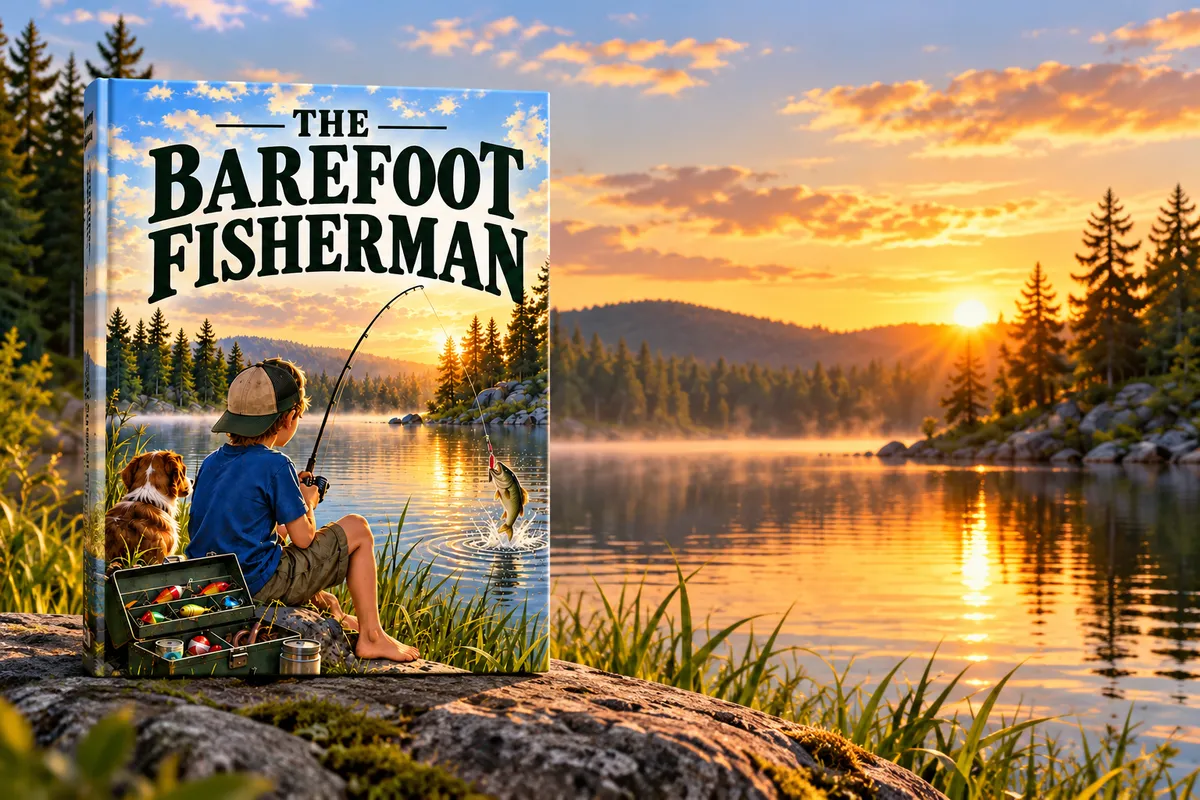
Why I Wrote The Barefoot Fisherman
When I was young, I loved fishing.
I remember searching the library for books that would teach me more about it. There were plenty of fishing books, but I couldn't find the one I really wanted.
They seemed to approach fishing from an adult's point of view.
I wasn't particularly interested in studying the technical differences between fishing reels.
I wanted to know how to catch more fish.
I wanted to know where to find bait, which fish might be hiding in different places, and how to catch the really big ones.
I wanted to learn about fishing from someone who remembered what it felt like to be a kid.
Years later, I wrote The Barefoot Fisherman because I still remembered that unsuccessful search through the library.
I wanted to write the fishing book I had been looking for.
A Children's Fishing Book Still Needs to Teach Fishing
Of course, children need to learn how to use a fishing rod.
They need to understand hooks, lines, reels, bait, and casting. They need to know how to approach the water and handle fish properly.
The Barefoot Fisherman teaches those things.
It covers fishing equipment, bait, lures, knots, different kinds of fish, and the practical skills a beginner needs.
But it also explores catching grasshoppers, raising worms, finding crawdads, and discovering the fascinating creatures that live in and around the water.
Those aren't distractions from learning to fish.
For many children, they're the very things that make learning to fish exciting.
The trick is to introduce the practical information in a way that connects with what a child already wants to discover.
What Makes a Good Fishing Book for Kids?
If you're a parent, grandparent, teacher, or librarian choosing a fishing book for a young reader, I think there are a few questions worth asking.
Does the book speak to children rather than simply explain things to them?
Children generally don't want to feel as though they're sitting through a lecture. They want to be included in the adventure.
Does it answer the questions children are likely to ask?
Where do fish hide? What do they eat? Can I catch my own bait? What's the biggest fish I might catch?
Does it make fishing seem approachable?
A child shouldn't finish reading an introductory fishing book believing that he or she needs hundreds of dollars' worth of equipment before getting started.
Most importantly, does it make the child want to go fishing?
A book can contain an enormous amount of useful information and still fail to awaken that desire.
For a beginning fisherman, inspiration is part of the education.
What Children Choose to Read Matters
This idea isn't limited to fishing.
Scholastic's Kids & Family Reading Report has repeatedly emphasized the importance of connecting children with books they actually want to read.
Children are more likely to embrace reading when they can explore subjects that genuinely interest them.
That doesn't mean every child wants the same kind of book. Some children love detailed diagrams and technical explanations. Others prefer stories, humor, pictures, or opportunities to experiment.
The important thing is to recognize those differences.
Rather than assuming we know what children ought to enjoy, perhaps we should pay closer attention to what excites them.
Learn more about Scholastic's research on children's reading interests.
Perhaps the Children Knew Something the Adults Didn't
One of the most gratifying experiences associated with The Barefoot Fisherman came when it became a finalist for Wisconsin's Golden Archer Award.
What made that recognition special was that the award was based on children's choices.
Children nominated books they enjoyed, and children voted.
The recognition helped lead to Scholastic Book Fairs purchasing 2,000 copies of The Barefoot Fisherman.
I was delighted, of course.
But the most meaningful part was knowing that young readers had connected with the book.
After all, they were the people I had written it for.
Sometimes the Best Way to Teach Is to Remember Being a Kid
When an adult looks at a fishing pond, he might think about water temperature, structure, seasonal patterns, or which lure would be most effective.
A child might wonder whether there's a monster bass hiding beneath those lily pads.
Neither perspective is wrong.
But if you're trying to introduce a child to fishing, I think it helps to begin with the second one.
The technical knowledge can follow.
The skills will develop.
And somewhere along the way, a child who started out chasing grasshoppers might become a very accomplished fisherman.
But first, you have to capture that child's imagination.
And that may be the most important thing a children's fishing book can do.
About The Barefoot Fisherman
Written by Paul Amdahl, The Barefoot Fisherman is an introduction to fishing created specifically for young readers. It combines practical instruction with the curiosity, humor, exploration, and excitement that make fishing such a wonderful childhood experience.
Whether you're introducing a child to fishing, looking for an outdoor adventure book, or searching for a gift for a young beginner, discover a fishing book written with kids in mind.
Explore The Barefoot Fisherman by Paul Amdahl
For a broader discussion of why education should begin with the learner's perspective, read Paul's companion article, Why Great Teaching Starts With the Learner, published by Docent Education.
